
“Family traditions cultivated at local permaculture farm”
July 2023
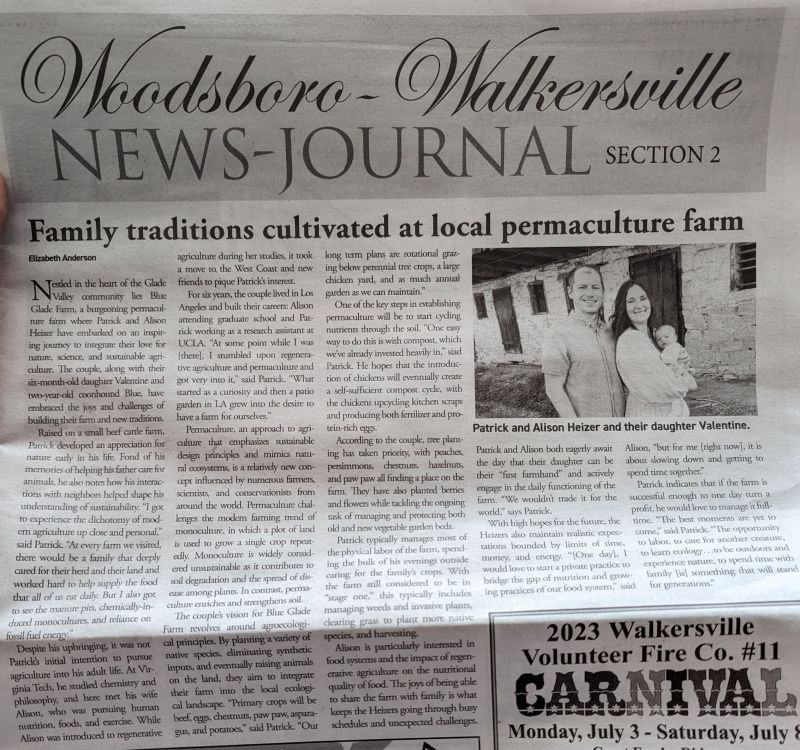
Nestled in the heart of the Glade Valley community lies Blue Glade Farm, a burgeoning permaculture farm where Patrick and Alison Heizer have embarked on an inspiring journey to integrate their love for nature, science, and sustainable agriculture. The couple, along with their six-month-old daughter Valentine and two-year-old coonhound Blue, have embraced the joys and challenges of building their farm and new traditions.
Raised on a small beef cattle farm in Hagerstown, Patrick developed an appreciation for nature early in his life. Fond of his memories of helping his father care for animals, he also notes how his interactions with neighbors helped shape his understanding of sustainability. “I got to experience the dichotomy of modern agriculture up close and personal,” said Patrick. “At every farm we visited, there would be a family that deeply cared for their herd and their land and worked hard to help supply the food that all of us eat daily. But I also got to see the manure pits, chemically-induced monocultures, and reliance on fossil fuel energy.”
Despite his upbringing, it was not Patrick’s initial intention to pursue agriculture into his adult life. At Virginia Tech, he studied chemistry and philosophy, and here met his wife Alison, who was pursuing human nutrition, foods, and exercise. While Alison was introduced to regenerative agriculture during her studies, it took a move to the West Coast and new friends to pique Patrick’s interest.
For six years, the couple lived in Los Angeles and built their careers: Alison attending graduate school and Patrick working as a research assistant at UCLA. “At some point while I was [there], I stumbled upon regenerative agriculture and permaculture and got very into it,” said Patrick. “What started as a curiosity and then a patio garden in LA grew into the desire to have a farm for ourselves.”
Permaculture, an approach to agriculture that emphasizes sustainable design principles and mimics natural ecosystems, is a relatively new concept influenced by numerous farmers, scientists, and conservationists from around the world. Permaculture challenges the modern farming trend of monoculture, in which a plot of land is used to grow a single crop repeatedly. Monoculture is widely considered unsustainable as it contributes to soil degradation and the spread of disease among plants. In contrast, permaculture enriches and strengthens soil.
The call of their East Coast roots and a growing interest in permaculture prompted the Heizers to seek a lifestyle different from the one they shared in California. In 2021, they sold most of their belongings, packed up their car, and made the long journey back to Maryland. After several months of searching, they found their current property on Glade Road. A picturesque 11.5-acre plot previously used as a horse farm, the land offered the Heizers the opportunity to bring their sustainable agriculture dreams to life.
The couple’s vision for Blue Glade Farm revolves around agroecological principles. By planting a variety of native species, eliminating synthetic inputs, and eventually raising animals on the land, they aim to integrate their farm into the local ecological landscape. “Primary crops will be beef, eggs, chestnuts, paw paw, asparagus, and potatoes,” said Patrick. “Our long term plans are rotational grazing below perennial tree crops, a large chicken yard, and as much annual garden as we can maintain.”
According to the master plan for Blue Glade Farm, located on Patrick’s blog The Counterpoint, one of the key steps in establishing permaculture will be to start cycling nutrients through the soil. “One easy way to do this is with compost, which we’ve already invested heavily in,” writes Patrick. He hopes that the introduction of chickens will eventually create a self-sufficient compost cycle, with the chickens upcycling kitchen scraps and producing both fertilizer and protein-rich eggs.
The challenges of establishing a sustainable farm are not lost on the Heizers, especially as they balance full-time careers and the responsibilities of raising a young child. During the day, Patrick works at AstraZeneca as a biomedical engineer, while Alison works as a registered dietitian–and mom. According to the couple, tree planting has taken priority, with peaches, persimmons, chestnuts, hazelnuts, and paw paw all finding a place on the farm. They have also planted berries and flowers while tackling the ongoing task of managing and protecting both old and new vegetable garden beds.
Patrick typically manages most of the physical labor of the farm, spending the bulk of his evenings outside caring for the family’s crops. With the farm still considered to be in “stage one,” this typically includes managing weeds and invasive plants, clearing grass to plant more native species, and harvesting. Of course, it also includes playing with Blue, who is just as important to the operation of the farm as its namesake.
Although Alison’s involvement in farming has been limited due to the birth of Valentine, she looks forward to more actively participating in the farm’s development alongside her daughter. As a registered dietitian, she is particularly interested in food systems and the impact of regenerative agriculture on the nutritional quality of food. The move to the farm has allowed her to reconnect with the outdoors and pursue her own passions, which include spending time with her family. “It is surreal to have accomplished so much of what we discussed and to be living what we dreamed about,” says Alison. “My favorite moments have been sitting on the upstairs front porch with Valentine and some coffee reflecting on this.”
The joys of being able to share the farm with family is what keeps the Heizers going through busy schedules and unexpected challenges. Patrick and Alison both eagerly await the day that their daughter can be their “first farmhand” and actively engage in the daily functioning of the farm. “We wouldn’t trade it for the world,” says Patrick.
With high hopes for the future, the Heizers also maintain realistic expectations bounded by limits of time, money, and energy. “[One day], I would love to start a private practice to bridge the gap of nutrition and growing practices of our food system,” said Alison, “but for me [right now], it is about slowing down and getting to spend time together.”
Patrick indicates that if the farm is successful enough to one day turn a profit, he would love to manage it full-time. “The best moments are yet to come,” said Patrick. “The opportunity to labor, to care for another creature, to learn ecology…to be outdoors and experience nature, to spend time with family [is] something that will stand for generations.”